
Environmental protection expenditures
Expenditure by government, businesses and households on environmental protection is an important indicator of the economic significance of environmental activities. Its level provides information on the financial resources devoted within an economy to the prevention, reduction or elimination of environmental pressures. However, low levels of expenditure do not necessarily indicate a low standard of environmental protection, as the effectiveness of environmental measures depends not only on the amount of resources invested.

Environmental Protection Expenditure Accounts (EPEA) record the financial resources used by resident economic units for environmental protection purposes. They therefore reflect the economic efforts made by government, businesses and households to protect the environment and implement the polluter-pays-principle.
National environmental protection expenditure comprises current expenditure and investments for environmental protection purposes, as well as the related financial flows with the rest of the world. These accounts show the resources devoted, either directly or indirectly, to environmental protection activities, regardless of whether the services are produced internally or purchased from other economic units.
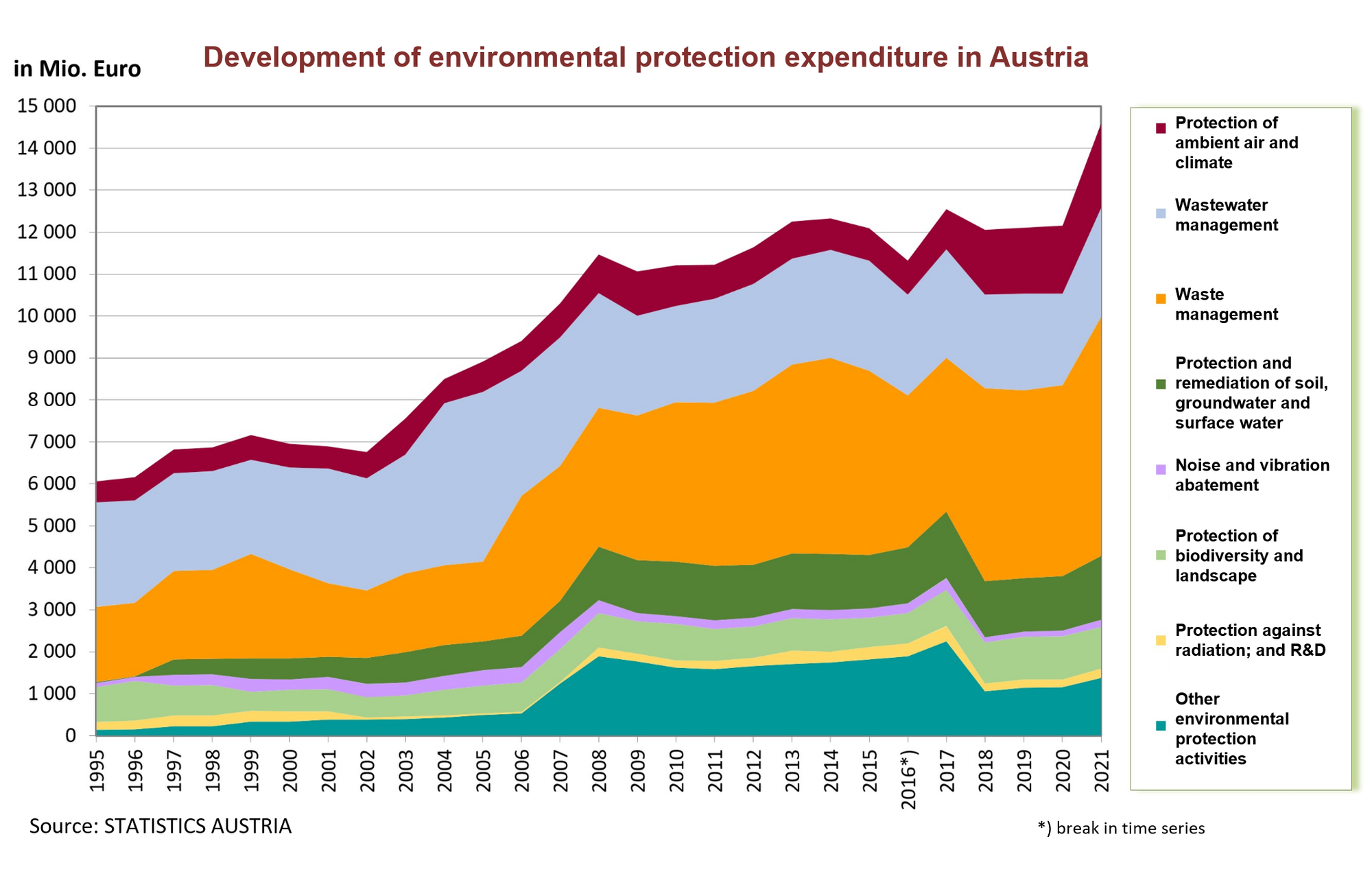
Environmental Protection Expenditure Accounts provide information on the production, use and financing of environmental protection services. They make it possible to quantify the economic importance of environmental protection, monitor developments in environmental protection investments and analyse the contributions of different sectors of the economy. In addition, they show which sectors bear the costs of environmental protection measures and how these costs develop over time. As such, they provide an important basis for the evaluation of environmental policies and for national and international comparisons.
The results of the Environmental Protection Expenditure Accounts support the monitoring of key national, European and international environmental, climate and sustainability objectives. They also provide valuable information on investments and current expenditure related to environmental measures that may contribute to the achievement of climate and energy goals. Thanks to their international comparability, the data enable the analysis of long-term developments and the assessment of policy measures at both national and European level.
Environmental protection includes all activities primarily aimed at the prevention, reduction or elimination of environmental pollution and other forms of environmental degradation. The scope of the accounts is based on the Classification of Environmental Protection Activities and Expenditure (CEPA), an internationally recognised standard for the classification of environmental protection activities and expenditure.
As part of the environmental accounts framework, Environmental Protection Expenditure Accounts link environmental and economic information. They contribute to a better understanding of the relationships between economic development, resource use and environmental pressures, and support the monitoring of the transition towards a sustainable and resource-efficient economy.