
Structure and compilation of Environmental Accounts
Environmental accounts are compiled in accordance with the System of Environmental-Economic Accounting (SEEA), the international framework developed by the United Nations for integrating environmental and economic information within a common statistical system.
Environmental accounts encompass different accounting approaches, which can broadly be classified into monetary, physical, and hybrid accounts. As the European legal framework has evolved, these accounting approaches have been expanded through additional modules, particularly in the areas of forests, ecosystems and environmental subsidies.

Three types of accounts are currently relevant for environmental accounting in Austria:
Monetary accounts
Monetary accounts record environmentally related economic activities and financial flows based on the principles of the national accounts. They are primarily used to analyse the economic impacts of environmental policies and environmental investments. Key examples include environmental protection expenditure, environmental transfers, and the Environmental Goods and Services Sector (EGSS).
Physical accounts
Physical accounts record the material and energy flows passing through an economy during a given period, as well as stocks of materials and natural resources. A distinction is therefore made between flow accounts and stock accounts.
In Austria, physical flow accounts mainly include material flow accounts, energy accounts, air emissions accounts, water accounts and waste accounts. In addition, information on natural resource stocks and ecosystems is becoming increasingly important as environmental accounts continue to evolve.
Hybrid accounts
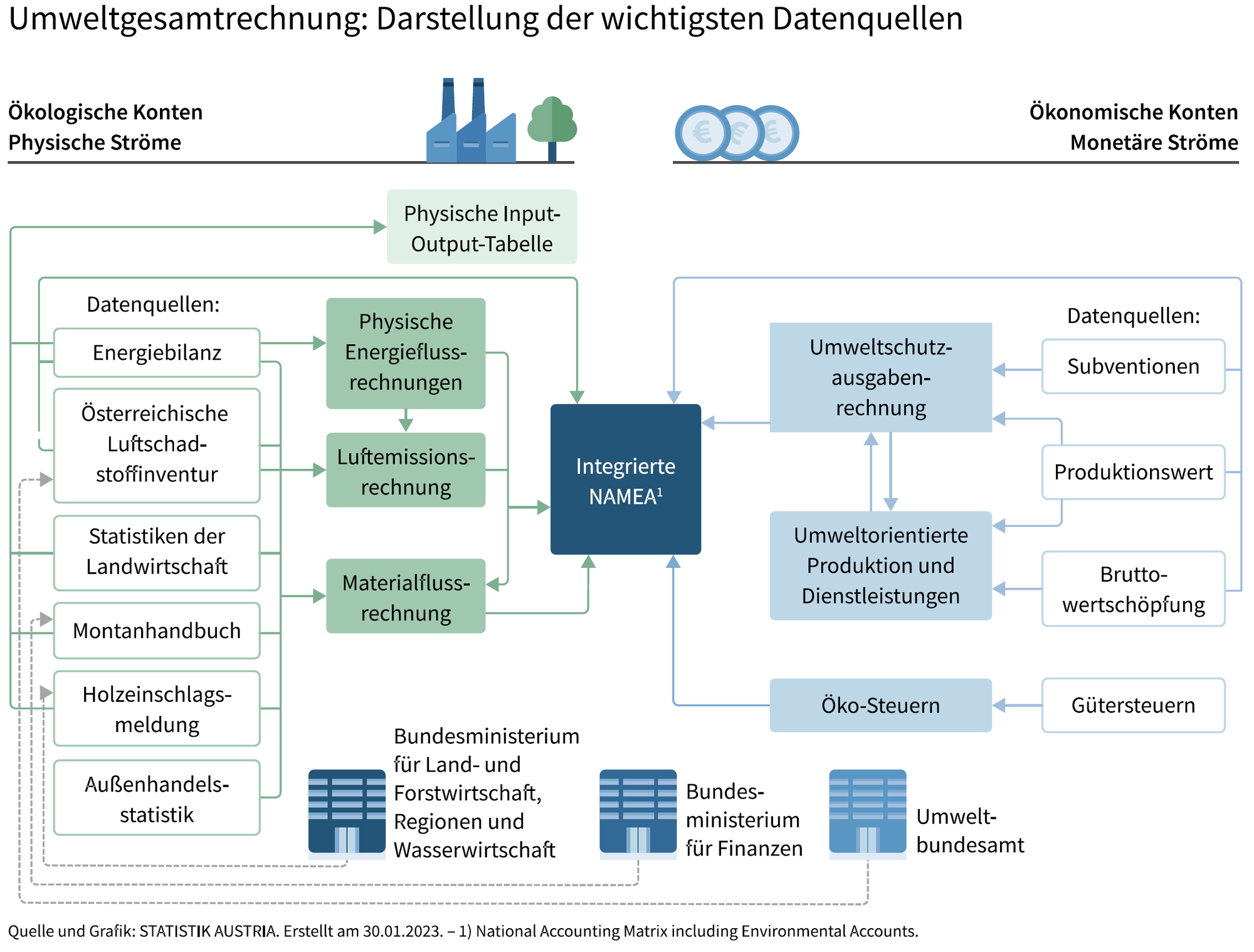
Hybrid accounts combine physical environmental information with economic data within a common accounting framework. This makes it possible to analyse the environmental impacts of economic activities by sector and relate them to economic indicators.
One example is the integrated NAMEA (National Accounting Matrix including Environmental Accounts) framework.
New modules of Environmental Accounts
To support the European Green Deal and other European environmental and sustainability strategies, the scope of European environmental accounts has been expanded. In addition to the existing modules, European environmental accounts now include:
- Forest Accounts
- Ecosystem Accounts
- Environmental Subsidies and Similar Transfers
These new modules enhance the statistical basis for analysing biodiversity, natural capital, resource use and environmental support measures. They complement the existing account types and, depending on the methodological approach, may include monetary, physical or combined elements.
As a result, key aspects of the ecological transformation of the economy and society can be captured more comprehensively within the statistical framework.
Read more…